

Every Piece Tells a Story
We never know what our volunteers will uncover during the International Coastal Cleanup. As they spread across Martin County’s beaches, parks, shorelines and waterways, they collect litter and debris of all kinds, from everyday trash to more unusual discoveries.
This year, much of what volunteers collected was the litter we see far too often: small pieces of plastic, cigarette butts, bottle caps, food wrappers and other common items that find their way into our natural spaces.
But one group found something much more unusual.
The Martin County High School Class of 2029 discovered a weathered wooden Lagoon Drift card, a find that earned them the title of Keep Martin Beautiful’s 2026 “Weirdest Find.”
At first glance, it looked like another piece of litter. It was part of Lagoon Drift, a citizen science study that uses ecofriendly wooden cards to better understand how water, marine debris and pollutants move through our regional waterways.
The program was first piloted in the Indian River Lagoon in 2019 under the direction and coordination of the Florida Department of Environmental Protection’s Indian River Lagoon Aquatic Preserves. When a card is found, the finder reports its location, date and time, giving researchers another data point to help track where floating debris travels.
It is a great example of how one small object can tell a much bigger story.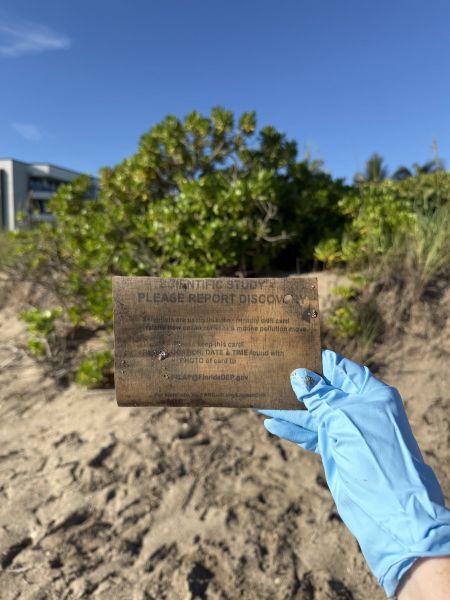
In many ways, that is also what happens during the International Coastal Cleanup.
Our volunteers are not simply picking up trash. They are collecting data.
This year, 1,116 volunteers joined Keep Martin Beautiful at 28 sites across Martin County, covering nearly 64 miles and removing more than 4,000 pounds of litter. Along the way, they recorded 32,984 individual pieces of debris.
One thing stood out. Much of that litter was small.
Volunteers documented 7,114 small plastic pieces, 6,910 cigarette butts and 5,266 bottle caps, along with thousands of food wrappers, foam fragments, lids and straws.
One bottle cap may not seem significant. Neither does one cigarette butt or tiny piece of plastic. But when thousands of people around the world record what they find using the same system, those individual pieces begin to reveal patterns.
The latest worldwide International Coastal Cleanup results show just how widespread some of those patterns are. Numbers from the 2026 cleanup are still being tallied as groups around the world submit their data, but in 2025 alone, volunteers collected more than 1.3 million plastic beverage bottles and nearly 886,000 plastic bottle caps from beaches and waterways around the world.
That is why the data matters.
It helps researchers, organizations and communities understand what types of litter are showing up most often, where debris is accumulating and where prevention efforts may have the greatest impact.
A Lagoon Drift card can help show us where one object carried by the water might go. A cleanup report can show us what thousands of objects collected year after year tell us about our habits and our environment.
We are always proud of the pounds of litter removed and the miles cleaned during the International Coastal Cleanup. But one of the most valuable things our volunteers collect may be information.
Because every piece tells a story, and the more closely we pay attention, the better equipped we are to change what that story looks like in the future.
To learn more about Keep Martin Beautiful visit, keepmartinbeautiful.org and be sure to follow on Facebook and Instagram.


